
Many people underestimate budgeting's power to build wealth, despite 69% living paycheck-to-paycheck while 86% know they should budget. Budgeting isn't just tracking expenses. It's the foundation for saving, investing, and managing multiple income streams that lead to financial independence. This guide explains how budgeting creates wealth, which strategies work best for individuals aged 25-45, and practical steps to apply budgeting knowledge without burnout. You'll discover evidence-backed methods, common challenges, and actionable tips to accelerate your wealth journey.
Table of Contents
- Key Takeaways
- Understanding budgeting's impact on wealth
- Budgeting strategies for financial independence seekers aged 25-45
- Navigating challenges and alternatives in budgeting for wealth building
- Applying budgeting knowledge to accelerate your wealth journey
- Explore budgeting tools and resources at CrownLeaf
- Frequently asked questions about budgeting and wealth
Key Takeaways
| Point | Details |
|---|---|
| Budgeting foundations | Budgeting gives you control over every dollar, enabling savings and wealth building. |
| Education boosts budgeting | Financial education makes budgeting three times more regular and strengthens long term stability. |
| Savings rate goal | Experts recommend saving at least 20 percent of income to build wealth and accelerate financial independence. |
| Automate savings | Automate your savings transfers on payday to reduce decision fatigue and maintain discipline. |
| Balance budgeting | Extreme budgeting can lead to burnout, so personalize and balance automation with money awareness. |
Understanding budgeting's impact on wealth
Budgeting creates wealth by giving you control over where every dollar goes. When you track expenses and prioritize savings, you build the foundation for financial independence. The most effective budgeting methodologies include zero-based budgeting, the 50/30/20 rule, and pay-yourself-first strategies that automate savings before discretionary spending.
Experts recommend saving at least 20% of income to build wealth effectively. Higher rates accelerate progress toward financial independence. The discipline of allocating income intentionally prevents lifestyle inflation and ensures consistent wealth accumulation over time.
Pro Tip: Automate your savings transfers on payday to remove decision fatigue and maintain discipline without constant willpower.
Financial education transforms budgeting success. Research shows financially educated individuals budget 3x more regularly than those without financial knowledge. This consistency compounds into better saving habits, higher net worth, and greater financial stability over decades.
The connection between education and budgeting behavior explains why some people thrive financially while others struggle despite similar incomes. Understanding concepts like compound interest, investment returns, and tax optimization motivates consistent budgeting behavior. Knowledge creates the "why" behind the discipline.
Three core budgeting benefits drive wealth creation:
- Expense visibility reveals spending patterns and identifies waste
- Savings prioritization ensures wealth building happens first, not last
- Goal alignment connects daily decisions to long-term financial independence
These benefits work together. Visibility without prioritization leads to awareness without action. Prioritization without goal alignment creates savings without purpose. Combining all three creates a powerful wealth-building system.
"Budgeting is telling your money where to go instead of wondering where it went. This shift from reactive to proactive money management separates wealth builders from paycheck-to-paycheck earners."
The methodology matters less than consistency. Zero-based budgeting works brilliantly for detail-oriented individuals who want complete control. The 50/30/20 rule offers simplicity for those who prefer broad categories. Pay-yourself-first budgeting suits people who struggle with traditional methods but can automate savings effectively.
Choose the approach that matches your personality and lifestyle. A simple budget you follow beats a complex budget you abandon. The best budgeting system is the one you'll actually use for years.
Budgeting strategies for financial independence seekers aged 25-45
Your income allocation determines your wealth trajectory. Financial independence requires aggressive savings rates that traditional budgeting advice often ignores. The FI community commonly saves 20-70% of income by prioritizing investment automation and controlling lifestyle inflation.

Multiple income streams offer tremendous growth potential but demand strict budgeting controls. Each income source needs tracking to prevent the illusion of abundance that leads to overspending. Treat side income as wealth-building fuel, not lifestyle upgrades.
Savings rate benchmarks for financial independence:
- 20% minimum for standard wealth building and comfortable retirement
- 30-40% for accelerated financial independence within 15-20 years
- 50%+ for aggressive FI seekers targeting independence within 10-15 years
- 60-70% for extreme savers pursuing FI in under 10 years
These rates assume consistent income and disciplined expense management. Higher rates dramatically reduce the time to financial independence through both increased savings and reduced lifestyle costs that continue after reaching FI.
Pro Tip: Calculate your FI number by multiplying annual expenses by 25, then work backwards to determine the required savings rate based on your timeline.
Lifestyle inflation destroys wealth faster than any other financial mistake. As income grows, the temptation to upgrade housing, cars, and discretionary spending grows proportionally. Set clear boundaries in your budget that cap lifestyle spending as a percentage of income, allowing raises and bonuses to flow directly into investments.
Follow these steps to create an FI-focused budget:
- Calculate total monthly income from all sources including salary, side hustles, and passive income
- Set your savings rate target based on your FI timeline and goals
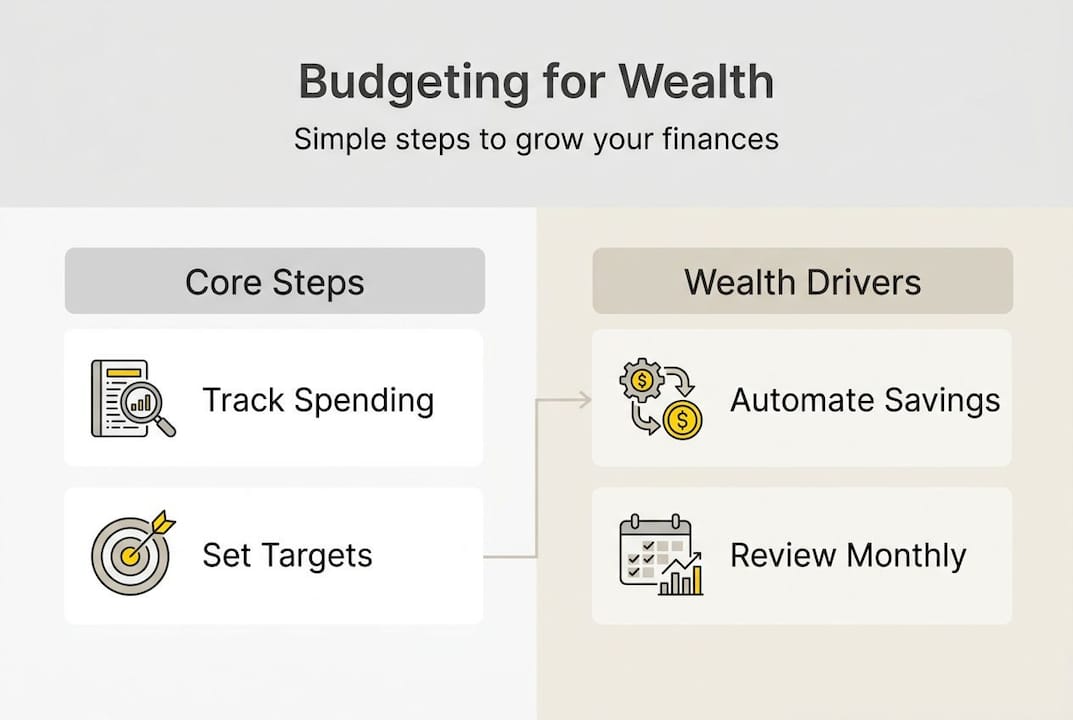
- Automate transfers to investment accounts immediately after income deposits
- Allocate remaining income to fixed expenses, then variable costs
- Track actual spending weekly to identify budget deviations early
- Review and adjust monthly to accommodate income changes and expense shifts
- Increase savings rate annually as income grows or expenses decrease
Automation removes willpower from the equation. When savings happen automatically, you budget around what remains rather than trying to save what's left after spending. This psychological shift makes high savings rates sustainable.
The key for 25-45 year olds is balancing current quality of life with future financial independence. Extreme deprivation leads to burnout and budget abandonment. Find your sustainable savings rate by gradually increasing the percentage over months until you feel mild discomfort, then back off slightly.
Multiple income streams require separate tracking:
- Primary employment income for baseline living expenses and core savings
- Side hustle income directed entirely toward investments or debt payoff
- Passive income reinvested or used for lifestyle optimization without guilt
This separation prevents mental accounting errors where you overspend because "side income covers it." Each income stream serves a specific purpose in your wealth-building strategy.
Regularly revisit your budget as income grows and life circumstances change. Marriage, children, career changes, and relocations all demand budget adjustments. Flexibility within a disciplined framework ensures long-term success without rigidity that causes stress.
Navigating challenges and alternatives in budgeting for wealth building
Budgeting challenges vary dramatically based on income level and stability. High earners face different obstacles than low-income individuals, while variable income creates unique complications for both groups.
| Income Level | Primary Challenge | Budgeting Solution |
|---|---|---|
| Low income | Limited discretionary funds after essentials | Focus on increasing income while minimizing non-essential costs |
| High income | Lifestyle inflation and lack of spending awareness | Automate high savings rates and set strict lifestyle spending caps |
| Variable income | Unpredictable monthly cash flow | Use floor budgeting based on minimum expected income |
| Multiple streams | Complexity and mental accounting errors | Separate tracking systems for each income source |
Research reveals high earners save more relative to lifetime earnings because discretionary income scales faster than essential expenses. Low-income individuals struggle with budgeting because every dollar goes to necessities, leaving no room for optimization or savings.
Variable income requires floor budgeting. Calculate your minimum monthly income over the past 12 months and budget essential expenses within that floor. Income above the floor goes directly to savings and investments. This approach maintains stability during low-income months while accelerating wealth building during high-income months.
Pro Tip: Maintain a three-month income buffer when dealing with variable earnings to smooth cash flow volatility without derailing your budget.
Alternative approaches challenge traditional budgeting dogma. Some individuals achieve financial success through money awareness and automation without detailed budgeting. They automate savings, track net worth monthly, and maintain general spending awareness without categorizing every transaction.
This alternative works for certain personality types:
- High earners with stable income and naturally frugal tendencies
- Individuals who find detailed budgeting psychologically draining
- People with strong financial education and money awareness
- Those who have already optimized major expenses like housing and transportation
Money awareness emphasizes understanding your financial position and making conscious spending decisions without rigid categories. You know your savings rate, investment balance, and approximate monthly spending without tracking every coffee purchase.
Extreme budgeting risks burnout and relationship strain. Tracking every penny, denying all discretionary spending, and obsessing over minor expenses creates unsustainable stress. Balance requires allocating guilt-free spending money for enjoyment while maintaining high savings rates.
The middle path combines automation, awareness, and flexibility. Automate your target savings rate, maintain awareness of major spending categories, and allow flexibility in minor discretionary areas. This approach captures most budgeting benefits without the psychological cost of extreme restriction.
Different life stages demand different budgeting intensity. Early career years may require detailed tracking to establish habits and overcome low income. Mid-career stability often allows simplified approaches focused on maintaining high savings rates. Late-career wealth building may emphasize tax optimization and estate planning over daily expense tracking.
Experiment to find your optimal approach. Try strict budgeting for three months to understand your spending patterns, then gradually simplify while maintaining your savings rate. The goal is sustainable wealth building, not budgeting perfection.
Applying budgeting knowledge to accelerate your wealth journey
Knowledge without application creates no wealth. These actionable steps transform budgeting concepts into financial independence progress.
Follow this implementation roadmap:
- Audit current spending by reviewing three months of transactions across all accounts
- Calculate your current savings rate by dividing total savings by gross income
- Set a target savings rate 5-10 percentage points higher than current
- Identify expense categories to reduce without sacrificing core values
- Automate savings increases immediately to lock in the new rate
- Track progress weekly for the first month to ensure sustainability
- Adjust as needed based on actual results and stress levels
- Increase savings rate again in six months if comfortable
Balance automation with conscious decision making. Automation ensures consistency, but awareness prevents autopilot spending on things that don't matter. Review automated systems quarterly to ensure they still serve your goals.
Set realistic savings targets aligned with your timeline. Research shows minimum recommended rates of 15-20% from age 30 for comfortable retirement, with higher targets essential for early FI. Your personal target depends on current age, existing wealth, and desired FI timeline.
Pro Tip: Use the 4% rule to calculate your FI number, then divide by your expected working years to determine required annual savings, accounting for investment returns.
Avoid these common budgeting mistakes:
- Ignoring emergency fund building in favor of immediate investing
- Setting unsustainable savings rates that lead to budget abandonment
- Failing to account for irregular expenses like insurance or vehicle maintenance
- Treating all debt equally instead of prioritizing high-interest payoff
- Neglecting to celebrate milestones, causing motivation decline
Emergency funds prevent budget destruction during unexpected events. Build three to six months of expenses in accessible savings before aggressive investing. This buffer allows you to maintain high savings rates without panic during job loss or major repairs.
Irregular expenses sabotage monthly budgets. Calculate annual costs for insurance, property taxes, vehicle maintenance, and similar items. Divide by 12 and budget monthly amounts into a separate account. When bills arrive, funds are ready without disrupting your budget.
Debt strategy affects wealth building speed. High-interest debt above 7% typically deserves aggressive payoff before investing beyond employer match. Low-interest debt below 4% often makes sense to maintain while investing for higher returns. Calculate the mathematical and psychological trade-offs for your situation.
Celebrate financial milestones to maintain motivation. Reaching your first $10,000, $50,000, or $100,000 invested deserves recognition. Small celebrations reinforce positive behavior without derailing progress. Budget modest rewards that align with your values.
Regularly revisit financial goals and adjust budgets accordingly. Life changes, priorities shift, and opportunities emerge. Quarterly reviews ensure your budget serves current goals rather than outdated plans. This flexibility within discipline creates sustainable wealth building.
The compound effect of consistent budgeting over decades creates extraordinary wealth. Small improvements in savings rate, investment returns, and expense optimization multiply over time. Focus on sustainable systems rather than perfect execution. Progress beats perfection.
Your wealth journey is unique. Use these principles as guidelines, not rigid rules. Adapt strategies to your income, personality, and goals. The best budget is one you'll maintain for years while building the financial independence you seek.
Explore budgeting tools and resources at CrownLeaf
Building wealth requires more than budgeting knowledge. You need practical tools and comprehensive strategies that connect budgeting to investment, income growth, and financial independence planning.

CrownLeaf offers The Wealth Blueprint, an e-book providing expert strategies for achieving multiple income streams and lasting wealth. This resource goes beyond basic budgeting to address the complete financial independence journey.
Key benefits include:
- Comprehensive frameworks connecting budgeting to wealth building
- Actionable strategies for developing multiple income streams
- Expert guidance on investment allocation and optimization
- Practical tools for tracking progress toward financial independence
Explore these financial tools at CrownLeaf to support your budgeting implementation and accelerate your path to financial freedom. The Wealth Blueprint complements the budgeting strategies covered in this guide by providing the broader context needed for complete financial independence planning.
Frequently asked questions about budgeting and wealth
What is the ideal savings rate for financial independence?
The ideal savings rate depends on your timeline and current age. A 20% rate supports standard retirement planning, while 40-50% enables financial independence within 15-20 years. Higher rates dramatically reduce working years through both increased savings and lower lifestyle costs that continue after reaching FI.
Can I build wealth without strict budgeting?
Yes, some individuals succeed through money awareness and automation without detailed budgeting. Automate your target savings rate, maintain general spending awareness, and track net worth monthly. This approach works best for high earners with naturally frugal tendencies and strong financial education who find detailed tracking psychologically draining.
How do multiple income streams affect my budget?
Multiple income streams require separate tracking to prevent mental accounting errors and overspending. Direct primary income toward living expenses and core savings, side hustle income entirely toward investments or debt payoff, and passive income toward reinvestment or guilt-free lifestyle optimization. This separation ensures each income source serves a specific wealth-building purpose.
Is extreme budgeting sustainable in the long term?
Extreme budgeting typically isn't sustainable and often leads to burnout, relationship strain, and eventual budget abandonment. Balance requires allocating guilt-free spending money for enjoyment while maintaining high savings rates. Find your sustainable rate by gradually increasing savings until you feel mild discomfort, then backing off slightly for long-term success.
What are quick tips for starting a budget today?
Start by calculating your current savings rate from last month's income and savings. Set a target rate 5-10 percentage points higher. Automate the increased savings immediately after your next paycheck. Track spending for one week to identify easy cuts. Focus on the big three expenses of housing, transportation, and food first, as optimizing these creates the largest impact with the least effort.