
Many people chase investment returns while overlooking the essential role of savings in building lasting financial security. Savings aren't just a backup plan, they're the bedrock of every successful wealth-building strategy. Without adequate cash reserves, even the best investment portfolio can crumble when unexpected expenses arise. This guide reveals why prioritizing savings over premature investing protects your financial future, how age and income shape saving patterns, and practical steps to build habits that lead to true financial independence.
Table of Contents
- Key Takeaways
- Why savings are the foundation of financial security
- Savings versus investing: building wealth the right way
- How age and income influence saving habits and rates
- Practical strategies to boost your savings and secure your financial future
- Start building your savings with CrownLeaf
- FAQ
Key Takeaways
| Point | Details |
|---|---|
| Foundation of savings | Cash reserves protect you from financial shocks and support stable payments during emergencies. |
| Emergency fund target | Aim for three months of essential expenses in a readily accessible emergency fund before investing. |
| Savings before investing | Starting with cash reserves reduces the need to liquidate investments during downturns. |
| Structured wealth steps | Follow a clear sequence such as a starter emergency fund, pay off high interest debt, expand the emergency fund to three to six months of essential expenses, maximize employer retirement match, and then begin systematic investing. |
Why savings are the foundation of financial security
Cash savings act as your first line of defense against financial shocks. When your car breaks down, medical bills arrive, or job loss strikes, accessible savings mean you handle these challenges without sliding into debt. Households with more cash savings have fewer missed payments even when controlling for liquidity, proving that the protective power of savings extends beyond simple math.
Think of savings as your financial immune system. Just as a healthy body fights off illness, a robust savings buffer fights off financial stress. Research shows that cash savings outperform higher discretionary income when it comes to preventing payment delinquencies. You might earn a decent salary, but without savings, one emergency can trigger a cascade of missed bills and mounting debt.
The psychological benefits matter just as much as the practical ones. Knowing you have money set aside reduces anxiety and improves decision-making. You're less likely to accept a terrible job offer out of desperation, more likely to negotiate better terms, and able to invest time in opportunities that build long-term value. Financial security starts with savings, not with chasing returns.
"Financial resilience requires liquid reserves that can be accessed immediately without penalty or market risk."
Consider these protective functions of savings:
- Emergency medical expenses covered without credit card debt
- Job loss buffer allowing time for quality employment search
- Home or vehicle repairs handled immediately
- Unexpected family obligations met without financial strain
Pro Tip: Calculate your monthly essential expenses (rent, food, utilities, insurance) and multiply by three. That's your minimum emergency fund target before you invest a single dollar.
Savings versus investing: building wealth the right way
The savings-first approach isn't about avoiding investing, it's about sequencing your financial moves correctly. Jumping into stocks or real estate before establishing cash reserves puts you at risk of liquidating investments at the worst possible time. When emergencies hit, you're forced to sell assets during market downturns, locking in losses and derailing long-term growth.
Save for short-term needs (0-3 years) and invest for goals beyond five years. This timeline distinction matters because savings accounts offer stability and immediate access, while investments require time to recover from volatility. Your emergency fund belongs in a high-yield savings account, not a brokerage account subject to market swings.
Follow this wealth-building sequence:
- Build a starter emergency fund of $1,000 to $2,000 for immediate small crises
- Pay off high-interest debt (credit cards above 15% APR)
- Expand emergency fund to cover 3-6 months of essential expenses
- Maximize employer retirement match (this is free money)
- Begin systematic investing for long-term goals
This approach balances security with growth. You're not leaving money on the table by saving first, you're ensuring you never have to raid your investment accounts during downturns. The investors who succeed long-term are those who can stay invested through market crashes because their savings cover emergencies.
Time horizon determines your tool. Need money within three years? Savings account. Building wealth for retirement in 30 years? Investment portfolio. Trying to buy a house in five years? Combination of both, weighted toward savings as you approach the purchase date. Consistent savings and investing together maximize wealth, but savings must come first.
Pro Tip: Automate transfers to savings on payday, treating savings like a non-negotiable bill. What's automated gets done, what requires willpower often gets skipped.
How age and income influence saving habits and rates
Savings behavior follows predictable patterns across the life cycle, though most people save less than financial models suggest they should. Retirement savings rates increase with age, from 4.5% at age 25 to 8.5% at age 65, though these rates fall below optimal levels recommended by economists. Understanding these trends helps you benchmark your progress and adjust strategies.

Younger workers face competing financial pressures: student loans, establishing households, and lower starting salaries. This explains why 25-year-olds typically save just 4.5% of income. As careers progress and income rises, savings capacity increases. By age 45, the average household saves around 7% annually. By 65, this climbs to 8.5%, though retirement experts often recommend 15% or higher throughout working years.
Income level dramatically affects saving ability and wealth accumulation. Higher lifetime earnings households save more, increasing wealth inequality over time. A household earning $150,000 annually saves a larger percentage than one earning $50,000, even after accounting for higher living costs. This compounds over decades, creating significant wealth gaps.
| Age Group | Average Savings Rate | Key Factors |
|---|---|---|
| 25-35 | 4.5-5.5% | Student debt, lower income, family formation |
| 35-50 | 6.0-7.5% | Peak earning years begin, mortgages, childcare costs |
| 50-65 | 7.5-8.5% | Higher income, reduced child expenses, retirement focus |
| 65+ | Variable | Transition to drawdown phase |
Several factors explain why actual savings fall short of theoretical models:
- Present bias: people value immediate consumption over future security
- Complexity: financial decisions overwhelm those without education
- Social comparison: spending keeps pace with peer groups
- Optimism bias: underestimating future expenses and risks
Cognitive and social factors influence savings more than pure math. Someone with strong financial role models and a sense of control over their financial future saves more consistently than someone with higher income but poor financial socialization. Your savings rate isn't just about what you earn, it's about your relationship with money.
Pro Tip: Review your savings rate annually and increase it by 1% each year. Small incremental changes compound into significant long-term results without feeling painful.
Practical strategies to boost your savings and secure your financial future
Building strong savings habits requires both practical systems and the right mindset. Start with clear, specific goals rather than vague intentions. "Save more money" fails, but "save $5,000 for emergencies by December" succeeds because it's measurable and time-bound. Break large goals into monthly targets that feel achievable.
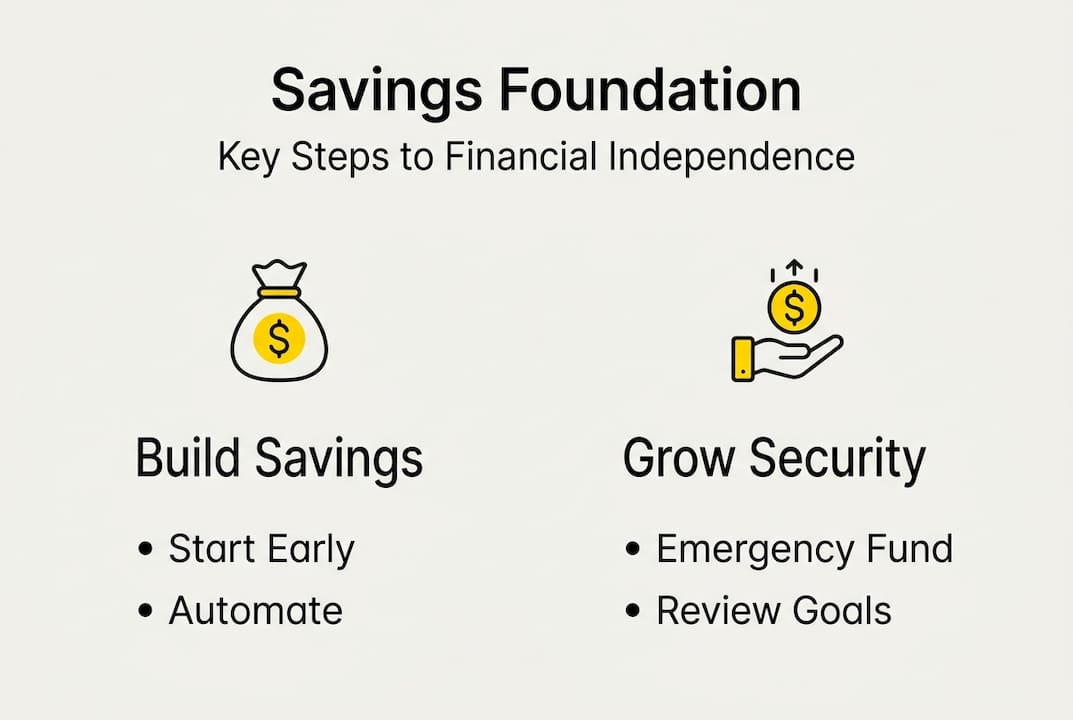
Automate everything possible. Set up automatic transfers from checking to savings on payday, before you see the money and before lifestyle inflation tempts you. Start with whatever amount feels comfortable, even if it's just $50 per paycheck. The habit matters more than the initial amount. You can increase transfers as income grows or expenses decrease.
Your emergency fund should cover 3-6 months of essential expenses, not total spending. Calculate rent, utilities, food, insurance, minimum debt payments, and transportation. If that totals $2,500 monthly, your target is $7,500 to $15,000. Higher earners and those with variable income should aim for six months. Stable employment and dual-income households can start with three months.
Psychological factors like internal locus of control and financial socialization boost savings habits significantly. Internal locus of control means believing your actions determine outcomes rather than external forces. People with this mindset save more because they see saving as effective. Build this by tracking small wins and connecting your actions to results.
Avoid these common savings pitfalls:
- Raiding emergency funds for non-emergencies like vacations or upgrades
- Keeping savings in checking accounts where they blend with spending money
- Waiting for "extra" money instead of saving from regular income
- Comparing your progress to others rather than your own goals
- Neglecting to increase savings rates as income grows
Review your savings strategy quarterly. Are you on track for goals? Has your income changed? Do your expenses reflect your priorities? Adjust automatic transfers up or down based on life changes. Financial education accelerates progress, whether through books, courses, or working with advisors. Surround yourself with people who value financial health and discuss money openly.
Pro Tip: Use separate savings accounts for different goals (emergency fund, vacation, home down payment). Visual separation makes it easier to track progress and harder to raid funds meant for specific purposes.
Start building your savings with CrownLeaf
Understanding savings principles is just the beginning. Applying them consistently requires the right tools and support. CrownLeaf provides resources designed specifically for individuals seeking financial independence through proven wealth-building strategies. The Wealth Blueprint e-book offers expert guidance on creating multiple income streams while maintaining the strong savings foundation discussed throughout this article.

Whether you're just starting your savings journey or looking to optimize existing habits, CrownLeaf delivers practical frameworks that turn knowledge into action. The platform simplifies complex financial concepts, helping you build both savings discipline and long-term wealth strategies. Take the next step toward financial independence by exploring how CrownLeaf can support your unique path to lasting financial security.
FAQ
What is the role of savings in personal finance?
Savings provide a financial cushion to handle emergencies and short-term needs, forming the base for long-term investing. Without sufficient savings, individuals often rely on debt during unexpected expenses, creating cycles of financial stress and missed payments. Cash reserves protect your ability to invest consistently by ensuring you never liquidate assets prematurely.
How much should I save before I start investing?
Financial experts advise building an emergency fund that covers 3-6 months of living expenses before investing. This ensures financial stability and reduces the need to liquidate investments prematurely during market downturns. Once your emergency fund is complete, you can invest confidently knowing short-term needs won't derail long-term growth.
Why do savings rates vary by age and income?
Younger individuals typically save less due to lower income and shorter retirement horizons, averaging around 4.5% of income at age 25. Higher income earners save more both in absolute dollars and as a percentage of earnings, contributing to wealth inequality trends over time. Life cycle patterns show savings rates rising to 8.5% by age 65, though these remain below optimal recommended levels.
What psychological factors help build strong savings habits?
A strong internal locus of control and positive financial socialization encourage consistent saving by connecting actions to outcomes. People who believe their financial decisions matter and who learned healthy money habits from family or mentors save more reliably. Following simple, rational savings rules like automating transfers and setting specific goals can improve long-term financial health regardless of income level.